
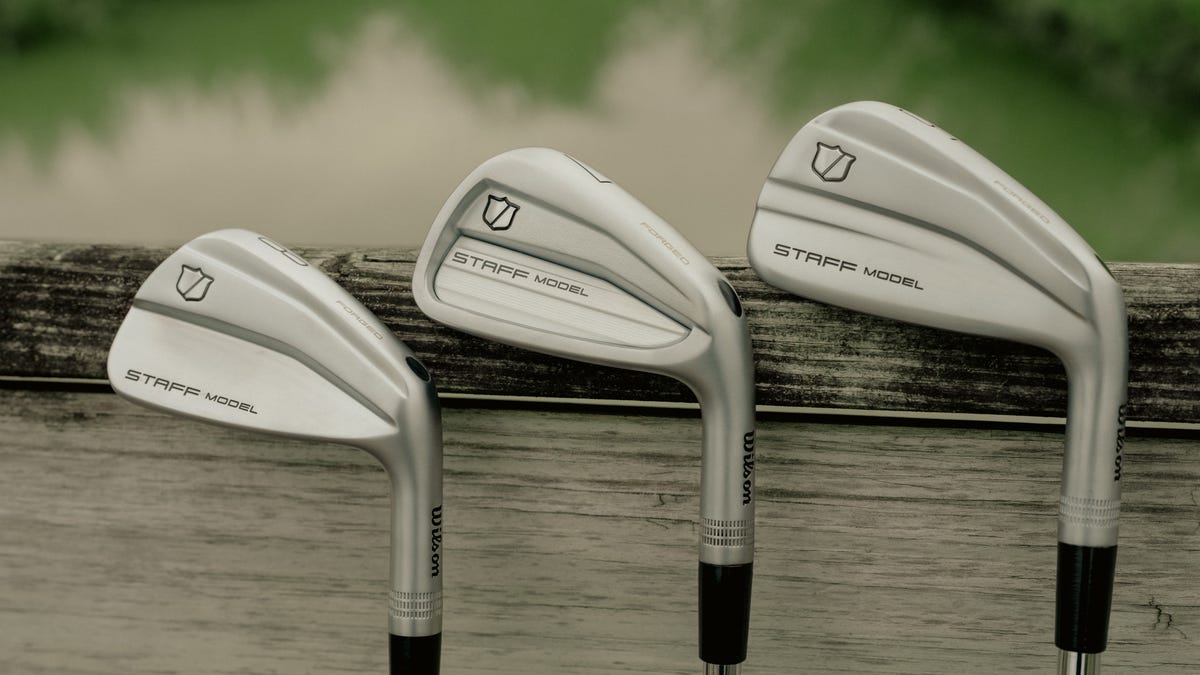
Wilson refreshes its Staff Model irons with updated Blade and CB designs and adds the new XB, a hollow-body option built for speed and forgiveness.
Gear: Wilson Staff Model Blade, Staff Model CB, Staff Model XB irons
Price: $1,399.99 (4–PW) with True Temper Dynamic Gold Mid 115 and Golf Pride Z Grip (Blade, CB); Nippon Modus Tour 110 (XB).
Specs: Forged 8620 carbon steel construction; Blade and CB are one-piece forged designs, while XB uses a forged hollow-body construction with internal urethane and tungsten weighting.
Available: By late February.
Who it’s for: The Wilson Staff Model Blade is designed for low single-digit handicap golfers who have a repeatable, powerful swing and demand the ultimate in control and feel. The Staff Model CB is for elite players who want more forgiveness than the Blade offers, while the XB is a better-player’s distance club that blends blade-like looks with enhanced forgiveness and ball speed.
What you should know: Wilson rebuilt its Staff Model iron lineup around a shared design language, adding a new better-player’s distance option in the XB while tightening the visual and performance gaps between Blade and CB.
The Deep Dive: There’s always been a certain expectation attached to the words “Staff Model.” For decades, gear given that designation has represented Wilson’s most traditional ideas about iron design: compact shapes, soft feel and the kind of feedback that tells you exactly where the ball met the face. For 2026, Wilson maintained that, while modernizing and expanding the lineup.
The biggest philosophical shift is how unified this iron family has become. The Blade, CB and the all-new XB were designed together, not as separate projects. That shows up immediately at address. Hosel length, topline thickness and overall proportions are intentionally aligned so that golfers can blend models without seeing abrupt changes from one iron to the next. That’s good, because Wilson expects combo sets to be common here, and the shaping supports that idea.
Across the lineup, the irons feature a brushed satin finish that moves away from the brighter chrome look of past generations. It reduces glare, softens the appearance at address and leans into the heritage cues Wilson wants to highlight, including hosel knurling, longer ferrules and a raised muscle feature that nods to classic Staff irons from the brand’s past.
The Staff Model Blade remains the purest expression of Wilson’s heritage. It’s more compact than before, with reduced offset and a shorter blade length designed to keep mass tight behind the hitting area. A variable hosel length helps fine-tune center of gravity (CG) placement while also ensuring visual consistency with the CB and XB. This is still a true muscleback, built for players who prioritize workability and feedback over forgiveness, so consider yourself warned.
The Staff Model CB sits in the middle of the three clubs, and Wilson spent considerable time narrowing the gap between it and the Blade. The CB’s hosel length now matches the Blade, while the hosel-to-face transition is smoother, and the offset has been reduced. The sole is straighter and narrower than before, improving turf interaction without pushing the design into muscleback territory. The result is an iron that retains some forgiveness but looks and feels closer to a traditional player’s iron than previous CB generations.
The most significant addition is the Staff Model XB, which introduces a better-player’s distance option into the Staff Model family for the first time. The XB is designed with a forged hollow-body construction to allow the face to flex more efficiently for increased ball speed while maintaining a compact shape. Each of the heads has been filled with urethane to dampen vibrations, and a tungsten slug in the 2–7 irons helps drive the CG location lower and encourages a higher launch angle.
What stands out in the XB is how much engineering went into internal geometry rather than visible technology. Wilson used topology optimization to determine where mass should be placed inside the head to balance ball speed, launch consistency and sound. That process led to internal rib structures, a parabolic mass pad and carefully positioned tungsten. You won’t see any of that, but they all enhance sound and feel.
Wilson’s internal testing suggests the XB produces similar launch and descent angles to the Blade and CB, with modest gains in ball speed, peak height and carry distance. That is achieved by the hollow-body design combining with slightly stronger lofts—generally 1 to 2 degrees stronger than the Blade and CB—while still maintaining playable descent angles into the green.
All three models are forged from 8620 carbon steel, chosen for its softness and consistency, and while the construction methods differ, Wilson’s goal was to keep feel and sound aligned across the family so golfers don’t feel like they’re switching categories when moving from one model to another.
Taken together, the 2026 Staff Model irons feel less like three separate products and more like a cohesive system. Wilson didn’t chase extremes here. Instead, it focused on shaping continuity, internal refinement and fitting flexibility. For golfers who’ve always liked the idea of a Staff Model iron but struggled to find the right blend of forgiveness and speed, this lineup should make that conversation easier.