
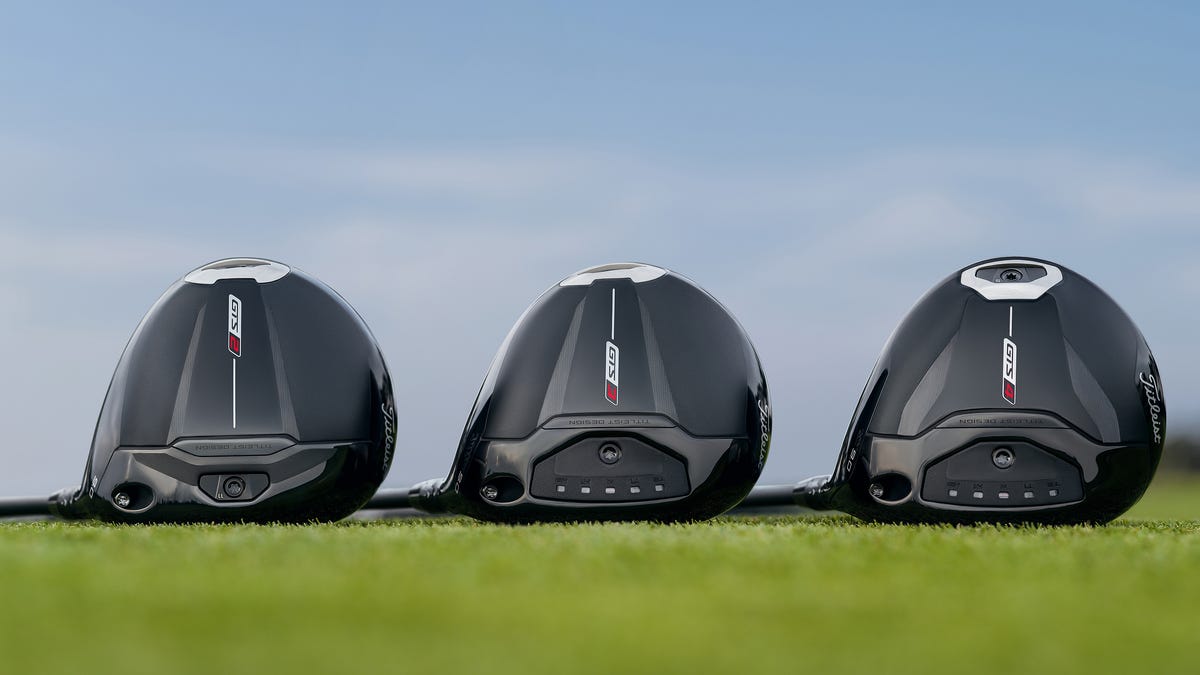
Titleist’s new GTS drivers use a thermoform polymer body to boost performance in three models that each have new levels of adjustability.
Gear: Titleist GTS2, GTS3 and GTS4 drivers
Price: $699 each with Project X Titan, Mitsubishi Tensei CK Blue, or Tensei CK White shaft and Titleist Universal 360 grip.
Available: May 13 (Fittings), June 11 (In Stores)
Who it’s for: Golfers who want more speed and distance, with greater adjustability and improved stability across the board.
What you should know: The Titleist GTS drivers replace nearly 60 percent of the head’s surface area with a thermoform polymer body, freeing up enough discretionary weight to boost speed, stability and adjustability.
The Deep Dive: Eight years is a long time to wait for a driver, but it’s roughly how long it took Titleist to go from discovering the thermoform polymer material (TPM) that is at the heart of the GTS family to actually manufacturing a driver built around it, at scale, to the brand’s standards. The GT drivers, launched in 2024, were a meaningful advancement over the TSi drivers, but they were also a proof of concept for TPM. It was the first time Titleist used the material in a driver, designing the crown that wrapped into the heel and toe areas with it. With the GTS, the concepts Titleist envisioned nearly a decade ago have been fully realized.
The “S” in GTS stands for speed, but it could also stand for stability even though those two things tend to fight each other in driver design. The GTS addresses that challenge by replacing the entire rear portion of the head, not just the crown, with its proprietary polymer.
The GT used 13 grams of TPM in the crown, but the GTS uses 26 in the crown sides and sole. In all, it’s nearly 60 percent of the head’s surface area, but accounts for only 13 percent of its mass. Using TPM instead of titanium frees up 27 to 30 grams of discretionary weight per model.
That reclaimed mass gets redistributed low and forward for ball speed, and in the back for a higher moment of inertia (MOI). The stainless steel housing that holds the back weight in every GTS model is also a concentrated mass element.
The aerodynamic head shapes benefit from the same construction because the lighter body panels allowed Titleist to raise the rear of the club higher, reducing drag in ways that weren’t previously possible, without elevated the CG location.
The face has been updated as well. Speed Ring, which was introduced in the GT drivers, still stiffens the perimeter of the hitting area to allow more deflection at center, but the top of the inner-facing ring is now open at the top, like horseshoe, to enhance performance on high strikes.
Titleist GTS2
The GTS2 is a 460cc head with the 16-position SureFit hosel that is available in 8, 9, 10 and 11-degree models for right- and left-handed players.
The most stable of the three models, it comes standard with a flat 11-gram weight in the forward port and a 5-gram weight in the back. That will confuse some people. Previous “2” models used a single rear weight to maximize MOI. Here, the heavier weight is up front.
Why? In past titanium builds, there was an internal mass pad forward in the sole, but in the GTS2, that pad is gone. The concentrated 11-gram weight in the front reproduces the CG position of the GT2 without the pad, while the rear weight boosts the MOI. The net result is same CG as before, with significantly higher stability.
Swap the weights — heavy to the back, light to the front — and CG shifts 2.5 millimeters rearward while MOI climbs, providing even more resistance to twisting on off-center hits, more spin and a higher launch angle without a reduction in ball-speed.
Titleist GTS3
The GTS3 is a 460cc head with the SureFit hosel, available in the same loft options as the GTS2. It retains its five-position front track that comes standard with an 8-gram weight to allow players and fitters to create a draw and fade bias.
What’s new is the 5-gram flat weight in the back, which is something the “3” drivers have never had. In stock configuration it delivers more speed from aerodynamics and the updated face, plus more stable from the elevated MOI.
Move the heavier weight to the back, and CG shifts rearward by 2 millimeters, adding 150 to 200 RPMs of spin, a higher launch angle and more stability.
Titleist GTS4
Titleist’s “4” drivers have always been low-spin options and niche products. While the GT4 was a 430cc head and less unforgiving, the GTS4 is 460cc and has a shallower profile.
While the size has been increased, the most interesting new feature of the GTS4 is the addition of directional adjustability for the first time. The GTS4 comes standard with an 8-gram weight on a five-position front track, plus a 5-gram rear flat weight. No “4” model has ever offered heel-to-toe CG movement. For players who need spin reduction, but who also need shot-shape control, it’s a genuine unlock.
The GTS4 is available in 8, 9 and 10-degree models with the SureFit hosel.