
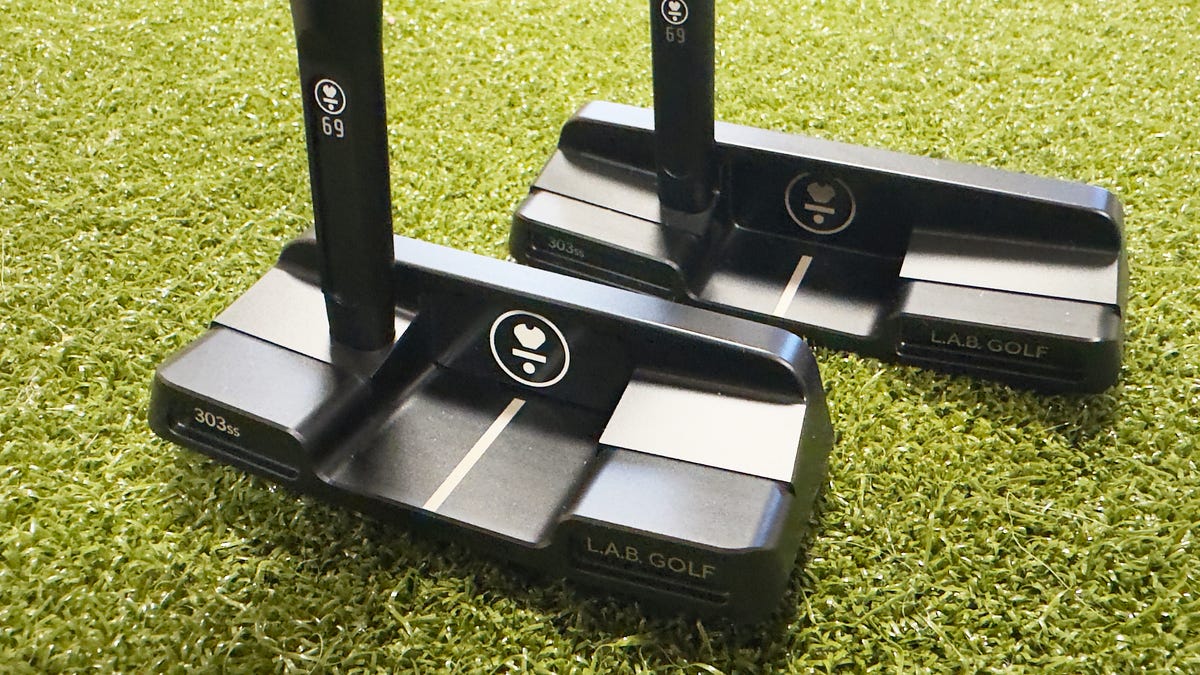
L.A.B. puts its Lie Angle Balance tech into classic blade shapes with the new heel-shafted LINK.2.1 and LINK.2.2 putters.
Gear: L.A.B. Golf LINK.2.1, LINK.2.2 putters
Price: $499 (stock), $599 and up (custom)
Specs: CNC milled 303 stainless steel head with black PVD finish. LINK 2.1 narrow blade, LINK 2.2 square-back blade. Custom options include lie angle, shaft length, head weight, alignment marking, shaft and grip.
Available: March 18 (online), April 23 (retail)
Who it’s for: Golfers who prefer the look and flow of a traditional heel-shafted blade but want more consistency in face control and start line.
What you should know: L.A.B. Golf has taken its Lie Angle Balance technology, which has largely lived in unconventional shapes, and built it into two classic-looking blade profiles. The result is a putter that looks familiar but swings like a zero-torque offering to keep the face square to the putting stroke’s path.
The Deep Dive: For years, L.A.B. Golf has asked golfers to rethink what a putter should look like if the goal is to make more putts. The company’s earliest designs like the DF2 and DF3 made that point clearly, even if they did not always win beauty contests.
The concept was simple: if you can reduce or eliminate torque in the putter head, you can make it easier to return the face square at impact and make putts roll down your intended target line more easily. That idea became Lie Angle Balance, and it has been the foundation of everything L.A.B. has built.
The challenge has never been performance. It has been getting golfers comfortable with the look.
That is where the LINK.2.1 and LINK.2.2 step in.
At address, both models check the boxes that traditionalists care about. The LINK.2.1 is compact and clean, with the proportions of a classic, narrow heel-toe weighted blade. The LINK.2.2 stretches that shape into a square-back profile, adding a little more size and stability without straying too far from familiar territory. Both are heel-shafted. Both sit square. Neither asks you to adjust your eyes or look at something unconventional.
What they do ask you to reconsider is how the putter moves.
Lie Angle Balance works by aligning the shaft axis with the putter’s center of gravity. When that relationship is correct, the head resists twisting during the stroke. Instead of opening or closing relative to your stroke’s path as you swing, it wants to stay square to the path.
For golfers, that changes the job description. Rather than managing face rotation with timing and feel, the goal becomes making a smooth, repeatable motion and letting the putter return to square on its own. Whether your stroke has a strong arc, a slight arc or very little arc at all, the face behavior becomes more predictable.
That predictability is what many players notice first. Putts tend to start closer to the intended line, and there is often less sense of needing to “fix” the face or use your hands and wrists.
Bringing the concept of Lie Angle Balance to a heel-shafted blade is where things get complicated. With a center-shafted mallet, it is relatively straightforward to align the shaft axis with the center of gravity. Move to a heel-shafted design, and the geometry shifts. The shaft axis moves depending on lie angle, and small changes in shape or mass distribution can throw everything off. That is why earlier L.A.B. models leaned toward larger, more unconventional forms.
The LINK putters borrow the idea of a variable-height hosel that debuted in the OZ.1 HS putters last season. By designing the hosel (which L.A.B. refers to as a riser) to be taller as the lie angle increases, L.A.B. designers could keep the shaft axis aligned with the center of gravity, solving the puzzle without giving up the look golfers prefer.
For a long time, the ideal scenario for L.A.B. has been clear: deliver Lie Angle Balance in a shape that does not require an adjustment period just to accept what you are looking at. A heel-toe blade that behaves like a torque-resistant design.
That is the lane the LINK.2.1 and LINK.2.2 are trying to occupy.
For golfers who have been curious about L.A.B. but hesitant to move away from a traditional blade, this could be the entry point. The setup looks familiar. The stroke feels different in a subtle way, but relatively quickly the benefit tends to show up in start line consistency and, for some players, improved distance control because the face is not being manipulated as much through impact.
That does not mean it will suit everyone. Some golfers rely on the sensation of the face opening and closing to create rhythm, and a more stable head can feel unusual at first. Like any putter, it still has to match your eye and your stroke.
But if you have ever stood over a putt feeling like you needed to be perfect to start the ball online, these designs are aimed directly at that problem.
L.A.B. has spent years proving that its technology works. The LINK.2.1 and LINK.2.2 suggest the company is now just as focused on how that performance is delivered to golfers who are not interested in making a visual compromise.
That combination of familiarity and function is what makes these feel different from anything the brand has done before. And it is why, for L.A.B., this might be as close as they have come to the putter they have been trying to build all along.